Court: Dalia Grybauskaitė’s Alleged Crimes Cannot Be Investigated
By Aurimas Drižius
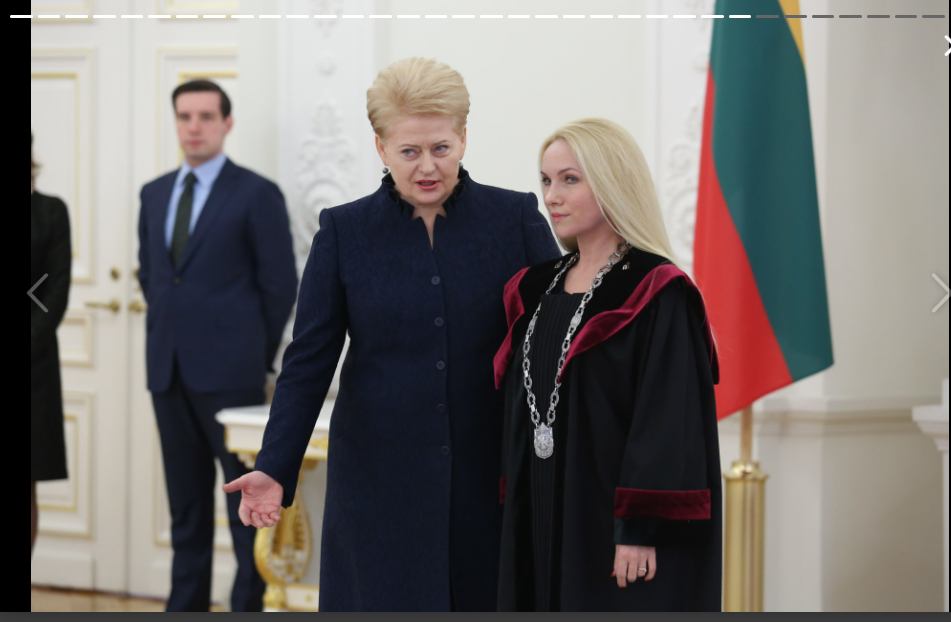
Judge Auksė Balkaitienė of the Vilnius City District Court (pictured above together with former President Dalia Grybauskaitė, who appointed her) ruled that it is impermissible even to initiate an investigation into the alleged crimes against justice committed by former President Dalia Grybauskaitė, because once such an investigation is opened, those crimes could potentially be uncovered and proven.
The court effectively blocked any investigation into these alleged crimes in advance, despite the fact that the very purpose of a pre-trial investigation is to collect and verify information concerning a potentially committed criminal offense. By refusing to carry out essential investigative measures, the authorities prevented any meaningful examination of the alleged violations from the outset.
In effect, the state authorities required the applicant to provide evidence that, by its very nature, can only be collected by the investigative authorities themselves.
As previously reported, the former President of the Lithuanian Court of Appeal, Vytautas Zelianka, publicly shared information regarding alleged threats made by former President Dalia Grybauskaitė against judges:
„Grybauskaitė’s methods were essentially the same as those used by the people she claimed to oppose.
Probably no one in Lithuania has done as much damage to democracy as she has.
Probably no one has contributed more to creating an atmosphere of fear, uncertainty, false patriotism, servility toward those with greater power, contempt for those with less power, and the replacement of dignity with personal benefit.
It was she who ensured that the judicial system became as toothless and spineless as possible.
Thanks to her, the lower courts became filled with judges constantly looking over their shoulders to see what those in power would think.
Even when nobody actually says anything.
Ten or fifteen years later, these same people may end up at the top of the judicial system.
How many decent people did she eliminate during her meetings with candidates for senior judicial positions at the Presidential Office?
How many brave judges were told that they no longer had any chance of career advancement because they had acquitted the wrong person, released the wrong suspect, or simply decided a case in a way that displeased her?
How many were deliberately humiliated by being told they wore the wrong shoes, the wrong jacket, or had the wrong father?
I personally know those cases and those names, and I wonder how many more I do not know.
Yet nobody dared to stand up to her.
My own form of protest was passive. While holding a certain office, I simply refused to do what I considered improper, especially when I was strongly pressured to do so.
Eventually, I resigned.
Open resistance was frightening and seemed impossible.
I remember how, about ten years ago, the State Security Department summoned me under the pretext of discussing work-related issues. Instead, they seated me alone in the brightly lit center of a windowless room, surrounded me in a circle, lectured me about patriotism, and made it very clear whose instructions they were following.
I also remember the disgraceful incident in the autumn of 2012, when the newly elected Judicial Council was invited to the Presidential Office. Laughing, Grybauskaitė spoke about secret information she supposedly possessed concerning the crimes of various political parties, and then declared that judges should not be granted too much authority because ‘all of you’—looking directly into our eyes—’are corrupt.’
At that time I had been in judicial administration for only a couple of months, and I was shocked to see the senior leaders silently lowering their heads and obediently listening to such statements.
These are the memories that come to my mind whenever I think about this President.
Let us not be afraid and let us not tremble.”
After these statements became public, I filed a complaint with the Prosecutor’s Office, arguing that Mr. Zelianka had described serious crimes against the administration of justice.
However, both the Prosecutor’s Office and the court refused even to initiate a pre-trial investigation into these allegations.
The obvious question remains: what if these allegations could have been confirmed through additional evidence and witness testimony?
If it were established that President Grybauskaitė had threatened judges, this could indicate violations of the constitutional principle of judicial independence and unlawful interference with the administration of justice.